Celestial signs and fate
The Romance of the Three KingdomsCelestial signs and fate are a recurring framework through which the novel interprets the rise and fall of rulers, the dangers of war, and the limits of human plans. Stars, sudden winds, storms, and ominous portents may appear to disclose Heaven’s judgment or foretell a death; yet the same signs also acquire meaning through the interpretations people give them, and can be folded into political claims or military stratagems. The result is not a simple system of reliable prediction: signs may guide action, dramatize uncertainty, or expose the distance between a ruler’s claim to legitimacy and the approval of Heaven.
Signs and political legitimacy
A striking early example joins a political discovery to an interpretation of destiny. After the destruction of the capital, Sun Jian finds a jade seal in a woman’s body at the bottom of a well. The seal bears the inscription that promises long life and prosperity to the recipient of Heaven’s mandate. Sun Jian’s adviser reads the discovery as evidence that Sun Jian is destined to rule and counsels him to head southeast and prepare for kingship. The object is concrete, but its political force comes from its association with the Mandate of Heaven: possession of the seal becomes a possible claim to authority, not merely the recovery of a lost imperial treasure.
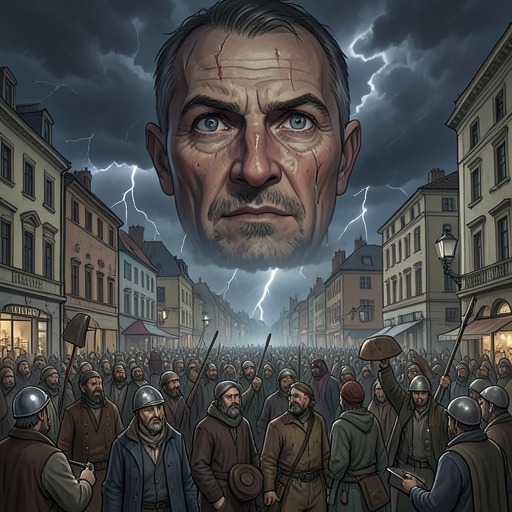
The novel also stages nature as a judge of political conduct. When the rebels attempt to bury Dong Zhuo at Meiwu, torrential storms repeatedly wash his coffin from the ground; the attempts end with the coffin destroyed and no remains left to bury. The narration presents this extraordinary sequence as Heaven making its anger against Dong Zhuo unmistakable. Here the sign is not a forecast requiring a later event to verify it. It is a moral verdict expressed through the failure of an imperial burial rite, turning the natural world against a ruler whose power had depended on violence and control.
The transfer of rule from Han to Wei brings a more openly contested use of celestial authority. At the abdication, astrologers brought forward by Hua Xin cite auspicious signs as proof that Heaven has removed the mandate from the Han and granted it to Wei. The former emperor rejects their interpretation, while Wang Lang presses him to accept that dynasties and families inevitably end. The signs therefore operate as arguments within a political struggle: they lend a cosmic frame to a transfer of power, but do not make that transfer feel consensual or uncontested.
The ritual that follows complicates the claim further. As Cao Pi begins worship of Heaven and Earth after accepting the jade seal, a violent storm overturns the ceremony’s lanterns and darkens the sky. He is frightened, incapacitated for days, and later believes the palace is haunted; he eventually orders a new palace built at Luoyang. Set beside the astrologers’ favorable reading, the storm makes the legitimacy of Wei’s accession appear unsettled. The same political transition is accompanied both by claims of Heaven’s authorization and by a portent experienced as Heaven’s displeasure.
Omens, mortality, and interpretation
The signs also carry intimate news of death. After Sun Quan’s defeat, Kong Ming tells Xuande that he had seen a shooting star fall in the northwest and interpreted it as the death of a member of the imperial family. A messenger then brings news that Liu Qi has died. Xuande grieves, and the conversation turns from the omen to practical consequences: they must arrange the funeral and decide who will take control of the city. In this episode, the celestial observation is quickly confirmed, but the scene does not leave the characters in passive contemplation of fate. The death changes the political situation, requiring immediate decisions about succession and territory.
Kong Ming again reads the night sky after Zhou Yu’s death, seeing a general’s star fall and a gathering of stars that signifies, to him, the assembly of skilled men in the east. He travels to Zhou Yu’s coffin under the stated pretext of paying respects, while carrying Zhao Zilong and five hundred warriors against possible plots. The image of a fallen star makes the death legible as part of a larger political pattern: the loss of a notable commander coincides with the presence of talent gathering in the rival eastern state. Celestial interpretation here informs both the emotional register of bereavement and Kong Ming’s assessment of political opportunity.
Yet the novel does not reserve signs for solemn foreknowledge. Before a dangerous night march, a sudden wind raises a dense cloud of dust that blots out the sun. Xuande treats it as an inauspicious omen, and Jian Yong, skilled in interpreting portents, warns that a terrible fate awaits them that night. He urges Xuande to save himself by abandoning the people; Xuande refuses, and the party takes defensive positions instead. Cao Cao’s forces attack before dawn, and Xuande nearly falls amid the fighting before Zhang Fei rescues him. The omen anticipates danger, but it does not settle the outcome: the characters’ choices and actions still shape who escapes and at what cost.
Celestial timing and military strategy
In military episodes, the boundary between heavenly timing and human calculation becomes especially unstable. Zhou Yu collapses as Cao Cao’s fleet approaches, after a strong wind drives Zhou Yu’s own standard into his face. The fallen flag and sudden wind appear to the southern commanders as ill omens; Zhou Yu, too, recognizes the danger in the wind’s direction. When Kong Ming visits him, he alludes to sudden winds from Heaven and identifies Zhou Yu’s unspoken anxiety: fire could defeat Cao Cao, but only if the wind blew from the east. The exchange turns a seemingly supernatural forecast into strategic knowledge. What troubles Zhou Yu is not simply an abstract prediction but a precise tactical condition on which the fire attack depends.
Kong Ming’s plan to obtain arrows shows the other side of that interplay. He sends boats into a dense fog, then has the sailors beat drums and shout near Cao Cao’s shore. Cao Cao mistakes the noise for an approaching attack and orders his archers and crossbowmen to fire into the fog. By morning, the straw bales on the boats are thick with arrows, and Kong Ming carries them away. Fog and human deception work together: the natural condition obscures the boats, while the enemy’s response supplies the weaponry. The episode makes advantage depend not on foretelling weather but on understanding how limited visibility will shape an opponent’s judgment.
This distinction matters across the novel’s wider strategic world. Cao Cao advances on a wall he believes to be weak, while Jia Xu recognizes that the apparent weakness and preparations elsewhere may be part of a deception. At Guandu, Xun You urges Cao Cao to attack quickly because his smaller army has limited supplies and cannot sustain a prolonged campaign. At Bowang, Kong Ming assigns separate ambushes and times their attacks to the sight of flames. These episodes do not hinge on celestial prediction, but they place human foresight, misinformation, terrain, timing, and scarcity beside the belief that Heaven may disclose an outcome. The narrative repeatedly gives strategic knowledge a concrete mechanism, while allowing signs and auspicious timing to enlarge the sense that events exceed any single commander’s control.
Prophecy and the limits of control
Prophetic language offers another way to connect present choices with a future that remains only partly understood. When Liu Gui persuades his companions to visit a sage, the Master initially ignores them, then writes eight lines beginning with the image of a dragon on one side and a phoenix on the other, flying toward the western rivers. The writing’s compressed, symbolic form does not explain itself at once. It invites interpretation and anticipation, making prophecy a narrative device that can point forward without immediately resolving what will happen.
Across these episodes, celestial signs and fate perform several related but distinct functions. A star may announce a death; a storm may condemn a tyrant or unsettle a new emperor’s legitimacy; a wind may reveal a military vulnerability; an omen may warn of danger without preventing it. Such signs do not erase agency. Xuande still chooses not to abandon the people, Kong Ming still designs a stratagem around fog, and commanders still have to weigh supplies, terrain, and deception. Nor do they supply a single uncontested account of political right: astrologers can be made to support a transfer of power even as the storm during its ritual seems to challenge it. The motif holds together the novel’s competing convictions that human beings must plan and act, that political authority requires more than force, and that neither foresight nor power can finally command the course of events.